Back to Berlin.
Sadly, we had bad weather, so you'll have to use your imagination when viewing the pictures below. Grey and rainy skies do not make for good photography. In addition, the bus and U-bahn drivers were on strike, making it slightly more of an effort to get around. Good for the old leg muscles, though walking in stormy weather wasn't the funnest thing ever. Still, without whiny boys, we were pretty much game for anything.

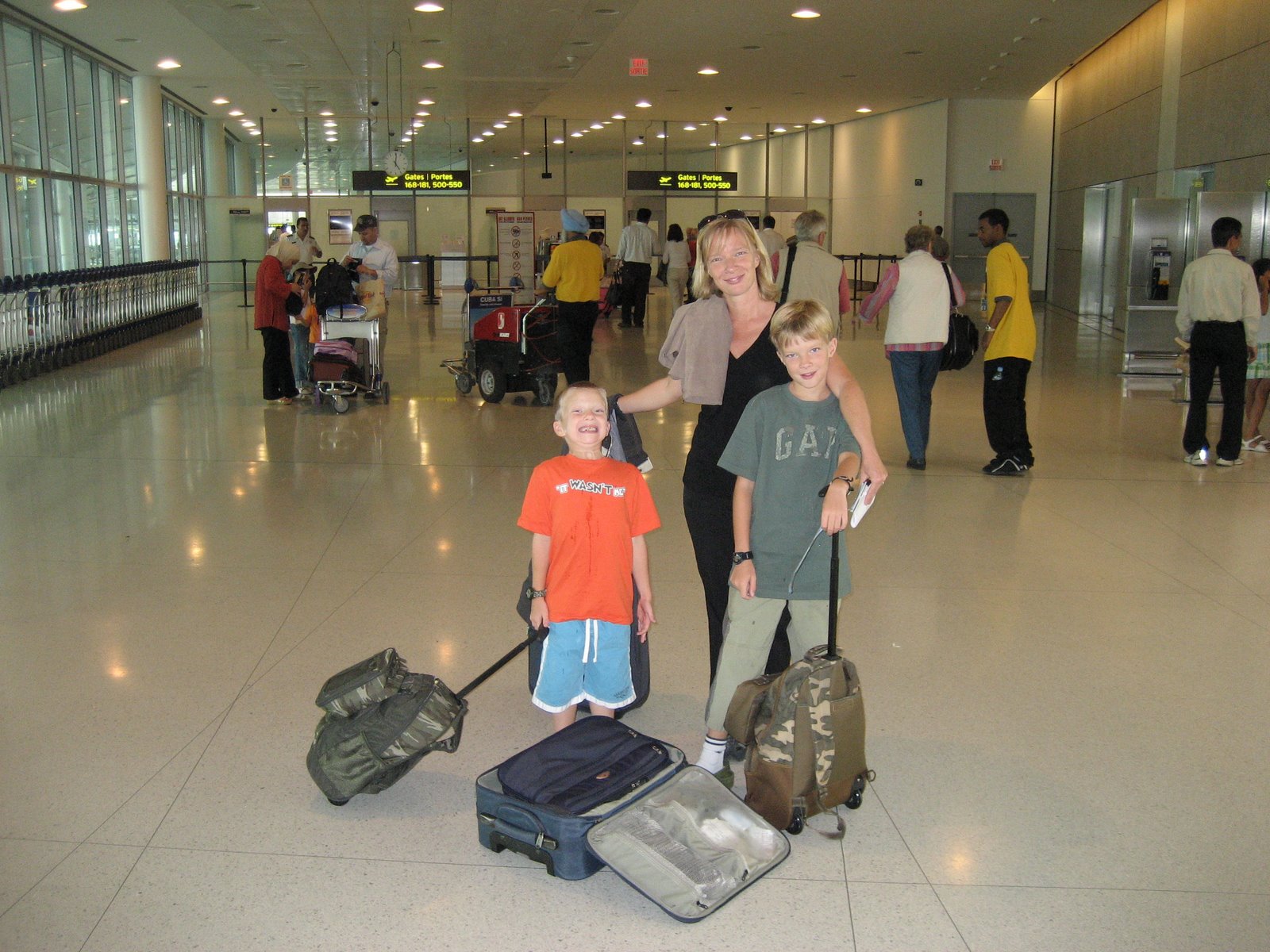
We flew into Schoenefeld airport, in former East-Berlin, and hopped on the train into town. On Mike's suggestion, I had booked a hotel near the Kurfurstendamm, the premier shopping street of former West-Berlin.
The very first thing that caught my eye as we stepped out of Zoo Station was the ruins of the Kaiser Wilhelm church:

Clearly this was once a building of monumental dimensions, but following a British RAF air strike in 1943, all that was left was the burned out remains of the belfry. At first, I was amazed that the city had kept these ruins, because it seemed to be such a harsh reminder of the war, but I soon realized that this was only one of numerous such mementos of the city's violent past.
We started our tour of the city by catching the train - the only public transportation still running - to the brand new Berlin Hauptbahnhof, the largest Central Station in Europe.
It is a sight to behold, all wrapped in wavy glass and steel, spanning several concourses and with the requisite shopping and free wi/fi making it a highlight of modern Berlin.
The Central Station is situated straight across for the German Reichstag building, which I posted a yummy chocolate version of yesterday. Although the external walls of the building date back to the 1800s, the building was completely gutted and renovated after German unification, and the dome was added as a nod to the cupola of the original building.
Entrance to the dome is free, provided you have the patience to line up in the rain and undergo an airport-like security screening. It offers a 360 degree view of Berlin, and directly below it, through a glass floor, the German parliament may be observed when in session. Sadly, the rain and wind were at their worst when we made it to the top of the dome, so we could only imagine the spectacular views you'd have on a sunny day. Still, the construction of the dome and the circular pathway to its top alone made it a worthwhile visit.

The Reichstag is just a stone's throw from the famed Brandenburger Tor. Brandenburger Tor was one of only a couple of structures on Pariser Platz to survive the relentless bombing leading up to the Nazi defeat in 1945. Dating back to the 1700s, this is one of the true jewels of the city. Even on a rainy and miserable day, the building took you back to another time, when citizens were only allowed to pass through the two outermost gates, while the Emperor entered through the middle arched entry and drove up Unter den Linden boulevard to the Palace:
Brandenburger Tor was of course also the site of President Reagan's famous - and incredibly well-timed - 1987 speech: "Mr. Gorbachev, tear down this wall!"
The most striking thing about modern day Berlin is the constant juxtaposition of venerable heritage buildings with new, modern, glass-and-steel construction. We saw several examples of this along the way, including this Frank Gehry signature inside a DZ Bank building connected to Brandenburger Tor:
What is it? I have no idea, and apparently neither does anyone else. Its sheer construction, though, is mind boggling, leaving us as puzzled and amused as when we caught sight of this entertaining addition to the German Historical Museum:
Much of new Berlin is like this - airy and fun. The Potsdamer Platz shopping mecca is a feat of engineering marvel, with the Sony roof astounding spectators as it lights up the night with the colours of the rainbow. For us, however, it proved a great place to find shelter from the biting rain and wind, as well as an opportunity to pick up an extra sweater for our trek onwards:
But as I alluded to earlier, don't be fooled by the lightness of new construction - you don't have to dig deep to find layers of Berlin's painful past. Memorials are everywhere - such as parts of the Berlin wall, still preserved by the entrance to the above-mentioned Potsdamer Platz:
Standing in front of the Sony and Daimler Chrysler Centres, it was difficult to imagine a time just 20 years ago, when neighbours could not meet and families could not visit. And yet, throughout Berlin, along the former site of the wall are memorial markings that do not allow us to forget:
For me the most heart-wrenching experience was the Holocaust memorial we visited a block south of the Brandenburger Tor:
It consists of 2711 slabs of concrete of various heights. It is stark, serious and shockingly effective.
We also visisted the Topography of Terror, an outdoor museum on the site of the headquarters of the SS and Gestapo during World War II. Having grown up in Europe, I studied the war extensively in school, but actually being on the site where so many of the atrocities took place brought it home in a much more real and personal way.
The museum displays are housed in the ruined cellars of the Gestapo headquarters, where many political prisoners were tortured and executed. Large placards with photos of victims being deported to their deaths still stun today. I don't think any visitor to the museum can help but feel horrified by the sheer evil that occurred in the 1930s and 1940s, particularly in central Europe.
Our lightening fast visit to Berlin was obviously quite the study in contrasts. I was not prepared to be so openly and brutally confronted with Europe's bloody past, but at the same time, I was also surprised by how far Berlin has come in its unification efforts. If it hadn't been for the wall markers along the streets, and the memorials, it would be impossible to tell former East Berlin from West Berlin, at least in the city centre.
It is absolutely to Berlin's credit that, while the city today is a world metropolis with great shopping, restaurants and architecture, it does not attempt to hide the atrocities of years gone by. Rather, these legacies have been incorporated into the present day, and help form a mosaic of human history that is absolutely unique to Berlin.
Moreover, Berliners are friendly, welcoming and helpful, my pathetic German notwithstanding, and the hotels are absolutely world class.
I only hope I have a chance to visit again (in better weather!) to enjoy a stroll along the beautiful Unter den Linden boulevard and perhaps go for a run around the Tiergarten park, or on the Charlottenburg Castle grounds.